 Skip to content

Many businesses compare custom socks and big-name brands by looking at price, lead time, or minimum order quantity. Those factors matter, but they rarely determine whether a product succeeds in the market.
The bigger difference comes down to control.
Big brands sell finished products designed for broad consumer demand. Custom sock manufacturing starts with the opposite goal. The product is built around a specific brand, audience, performance requirement, or retail strategy. That difference affects everything from fit and materials to packaging and repeat-order consistency.
For retailers, promotional product companies, sports organizations, and private label brands, understanding those differences can prevent costly sourcing mistakes later.
Quick Comparison – Custom Socks vs Big Brands
| Factor | Custom Socks | Big Brand Socks |
|---|---|---|
| Product Design | Built to your specifications | Pre-designed products |
| Materials | Flexible yarn and fabric options | Fixed material choices |
| Logo Integration | Fully customizable | Not available |
| Packaging | Custom branding available | Standard retail packaging |
| MOQ | Usually starts from bulk quantities | No MOQ |
| Lead Time | Production required | Immediate availability |
| Reordering | Controlled by your specifications | Dependent on retailer inventory |
| Brand Ownership | Full ownership | Owned by the manufacturer |
| Product Differentiation | High | Limited |
For businesses focused on long-term brand growth, product control often becomes more valuable than immediate availability.
The Biggest Difference Is Product Ownership
Big brands are built around standardization.
Their products must appeal to thousands or millions of customers, which means sizing, materials, cushioning, colors, and packaging are designed to satisfy the average buyer.
Custom manufacturing works differently.
Instead of choosing from an existing catalog, businesses decide what the sock should be and how it should perform. Material blends, knitting structures, logo placement, packaging, and sizing can all be adjusted according to the intended use.
This doesn’t simply create a unique product. It creates a product specification that belongs to the brand rather than the supplier.
That distinction becomes increasingly important when a company begins placing repeat orders or expanding into multiple product lines.
Why Fit Control Is Difficult for Mass-Market Socks
One area where custom manufacturing often creates an advantage is sizing.
Most retail socks are designed around average foot proportions. That sounds reasonable until you consider how much foot shape actually varies between people.
Research into sock sizing shows that foot circumference, ankle circumference, arch dimensions, heel measurements, and calf proportions can differ significantly even among people wearing the same shoe size.
A standard retail sock cannot realistically accommodate every variation.
This is why some consumers experience socks that slide down during the day, bunch inside shoes, feel tight around the arch, or become loose after extended wear.
Custom sock production allows brands to design around a specific customer group rather than the average customer.
A Pilates studio may prioritize a secure fit around the arch and ankle. A workwear brand may require additional reinforcement and cushioning. A sports team may need compression zones designed around athletic performance rather than casual wear.
The result is often a product that feels more intentional because it was designed for a specific purpose.
How Sock Construction Changes the Product
Many buyers focus on materials first.
In reality, construction often has an equal or greater influence on how a sock performs.
Two socks made from similar yarns can feel completely different depending on how they are knitted.
For example, athletic products frequently use terry cushioning in high-impact areas to improve comfort and reduce abrasion. Ribbed structures help socks stay in position throughout the day. Mesh-knit zones improve airflow and moisture management. Compression sections can provide a more supportive fit without increasing fabric thickness.
Large retail brands often standardize these features across multiple product lines to simplify production.
Custom manufacturing allows brands to decide which features deserve emphasis based on how customers actually use the product.
This level of control is difficult to achieve when purchasing finished retail inventory.
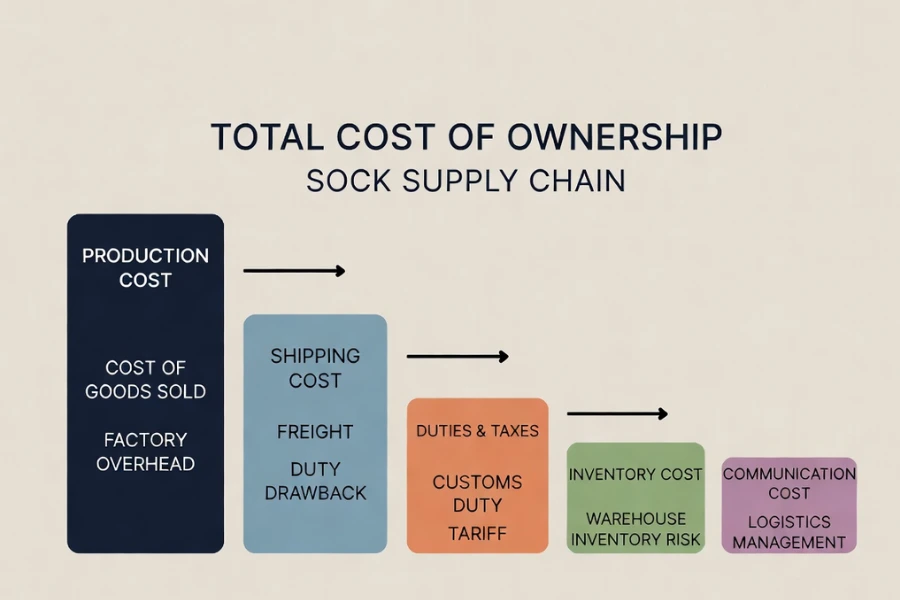
MMaterial Selection Involves More Than Cotton and Polyester
Material discussions often become overly simplified.
Many buyers compare cotton, polyester, bamboo, wool, or nylon as if the decision were only about softness or comfort. In reality, performance depends on both fiber selection and knitting structure.
A cotton-rich sock may feel comfortable initially but wear differently depending on yarn quality and construction. Moisture management can vary substantially between two products that appear similar on paper.
Custom manufacturing makes it possible to build material blends around the intended application.
Sports products often prioritize durability and moisture control. Retail fashion products may emphasize color clarity and softness. Corporate gifting programs frequently focus on comfort and presentation.
Instead of adapting a product to available materials, brands can align materials with product goals.
How Logo Integration Works in Custom Manufacturing
Many people assume branding simply means adding a logo to an existing sock.
The reality is more technical.
Modern sock development uses digital design systems that allow logos, graphics, and patterns to become part of the knitted structure itself. Depending on the desired outcome, branding may be incorporated through jacquard knitting, embroidery, sublimation printing, or full-surface printing methods.
Each approach creates different visual and functional results.
A knitted logo becomes part of the fabric and typically maintains flexibility during wear. Embroidery can create a more dimensional appearance but may introduce additional thickness. Printed methods allow highly detailed artwork and photographic designs that would be difficult to achieve through knitting alone.
This is one of the clearest differences between custom products and big-brand inventory.
With retail products, branding decisions have already been made.
With OEM or private label manufacturing, branding becomes part of the product development process itself.
Why Reorder Consistency Matters More Than Initial Price
Many first-time buyers focus heavily on the initial quotation.
Experienced buyers usually focus on what happens six months later.
A product that cannot be reproduced consistently creates inventory problems, customer complaints, and unnecessary sourcing risk.
Color matching, sizing consistency, yarn specifications, logo placement, and packaging details all become increasingly important as order volumes grow.
A supplier that produces an excellent sample but struggles with repeat production can create larger long-term costs than a supplier with a slightly higher unit price.
This is why quality control systems matter.
The objective is not simply receiving socks. The objective is receiving the same socks every time.
For growing brands, consistency often becomes one of the most valuable parts of the manufacturing relationship.
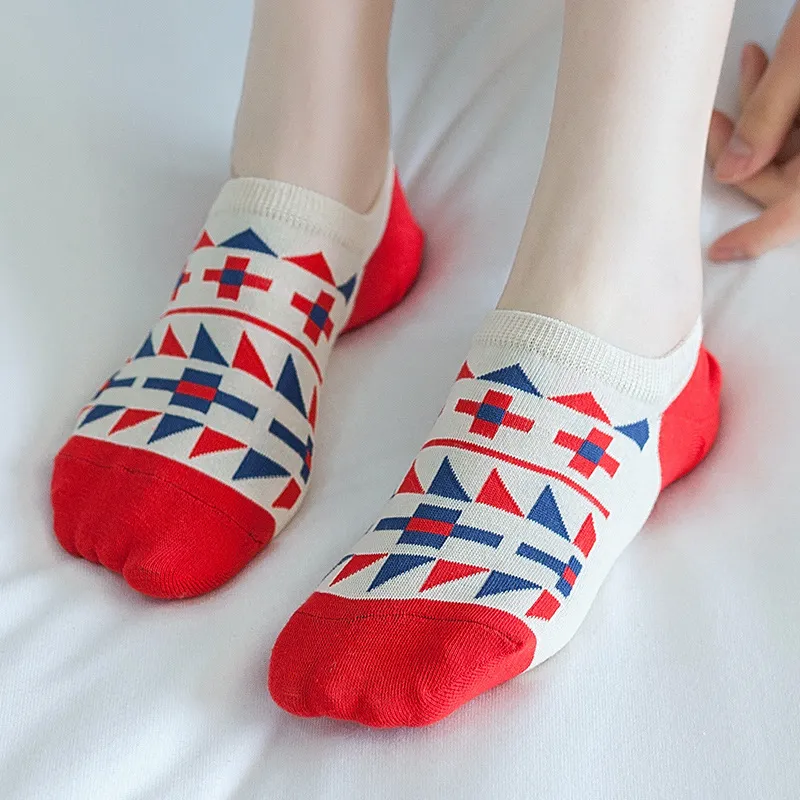
The Hidden Costs Most Buyers Miss
Unit price tells only part of the story.
The total cost of a sock program often includes inventory carrying costs, shipping expenses, packaging requirements, communication efficiency, production delays, and reorder management.
For example, a low-cost supplier may require larger production runs that increase storage requirements and inventory risk. A slightly higher production cost may allow more flexible quantities and faster product updates.
The cheapest option is not always the most economical option.
For many brands, flexibility creates value that never appears on a quotation sheet.
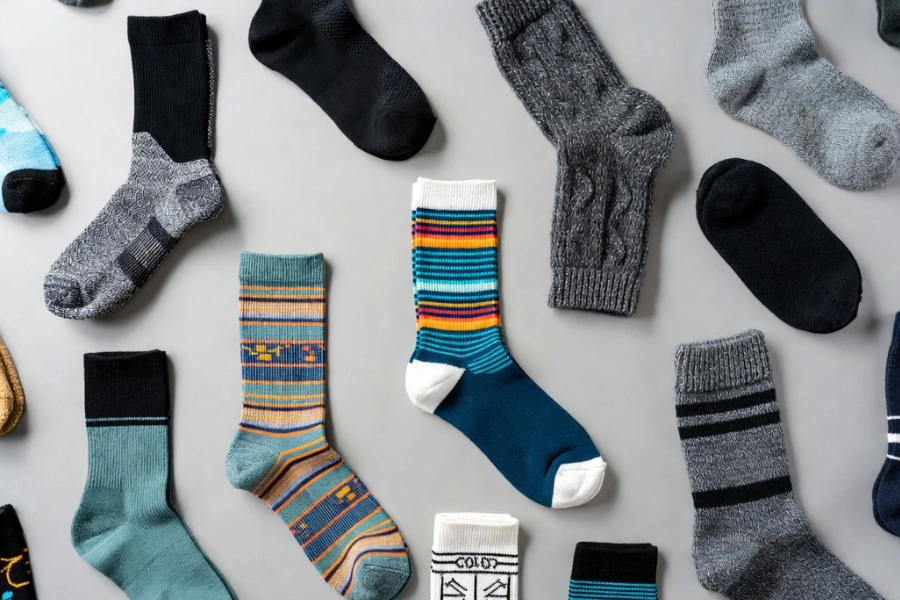
When Big Brands Make More Sense
Custom manufacturing is not always the best solution.
Buying established retail products often makes sense when products are needed immediately, customization is unnecessary, or the market is still being tested.
Retail inventory can also be useful for short-term events, temporary resale opportunities, or businesses that do not yet require proprietary products.
In these situations, convenience may outweigh customization.
When Custom Socks Make More Sense
Custom production becomes more attractive when socks are part of a broader business strategy.
Private label retailers, sports organizations, wellness studios, corporate gifting programs, subscription brands, and promotional campaigns often benefit from having greater influence over product specifications.
Custom manufacturing allows these businesses to control fit, branding, packaging, and product positioning while creating something competitors cannot purchase from the same catalog.
As a brand grows, that differentiation often becomes increasingly valuable.
How to Evaluate a Custom Sock Manufacturer
Choosing a manufacturing partner involves more than comparing quotations.
A reliable supplier should be able to explain how sizing is managed, how different knitting structures affect performance, how branding methods influence the final appearance, and how quality is maintained across production runs.
It is also worth reviewing sample procedures, communication responsiveness, production transparency, and reorder management processes.
The strongest manufacturing relationships reduce uncertainty rather than simply reducing cost.
At SocksMaven, we regularly work with brands that need practical guidance on material selection, logo execution, packaging decisions, and long-term reorder planning. The goal isn’t simply producing socks. It’s helping businesses create products that remain consistent as they scale.
FAQ
Are custom socks always more expensive than big-brand socks?
Not necessarily. Custom production may require development costs and minimum quantities, but it can create stronger branding, better differentiation, and greater control over future orders. For many growing businesses, those advantages offset the higher upfront investment.
Why do custom socks sometimes fit better than retail socks?
Retail products are usually designed around average sizing assumptions. Custom programs can be developed around specific customer groups, allowing adjustments to fit profiles, cushioning placement, compression zones, and overall construction.
Can a custom manufacturer replicate an existing sock design?
In many cases, yes. An experienced supplier can often develop a similar construction, material blend, and appearance while adjusting features to suit branding, packaging, or performance requirements.
What affects consistency between production runs?
Yarn specifications, machine settings, color matching procedures, quality inspections, and production documentation all influence consistency. Suppliers with established quality control processes generally achieve more reliable repeat-order results.
Is private label manufacturing better than reselling branded socks?
That depends on business goals. Reselling branded products offers speed and simplicity. Private label production provides greater control over product positioning, branding, pricing strategy, and long-term differentiation.
Final Thoughts
Big brands make purchasing easy.
Custom manufacturing gives businesses control.
If the goal is simply acquiring inventory, retail products may be enough. If the goal is building a recognizable brand, creating unique products, and maintaining long-term control over quality and presentation, custom sock manufacturing often becomes the stronger choice.
The most successful brands rarely compete by selling the same product as everyone else. They compete by creating products that are distinctly their own.

