Skip to content

If you manage a team, run sports events, or build a merchandise brand, here’s the real issue.
Are standard sports socks enough for performance consistency and brand visibility?
Short answer
No. Sports socks evolved from basic protection to engineered performance gear. Today, custom sports socks improve athletic results and strengthen brand identity at the same time.
This guide explains how we got here and why custom production has become a smart B2B decision.
How Sports Socks Became Performance Equipment

Understanding the history shows why custom is no longer optional.
Early Era – Pure Protection
In the late 1800s and early 1900s, athletes wore:
- Heavy wool socks
- Knee-high lengths
- Moisture-absorbing fabrics
These socks protected skin from rough leather shoes. They trapped sweat and caused friction. Performance was not the priority.
Mid-20th Century – Team Identity Takes Shape
As organized sports grew, socks became part of the uniform system.
- Cotton replaced wool
- Tube socks became popular
- Stripes reflected team colors
Socks started carrying visual identity. Technology, however, remained basic.
The Performance Shift – Fit and Function Matter
As sports became faster and more competitive, gear had to improve.
Blended materials entered production. Cushioning zones improved impact control. Elastic fibers enhanced fit.
Teams noticed something practical. A better-fitting sock reduced foot slippage inside the shoe. That meant sharper cuts and fewer blisters.
Socks stopped being an afterthought.
Modern Engineered Athletic Socks

Today’s sports socks are designed around four goals:
- Moisture control
- Targeted cushioning
- Stability and compression
- Long-term durability
Polyester blends wick sweat. Nylon adds strength. Spandex maintains structure.
At this stage, generic retail socks often fall short for teams and branded programs.
Why Teams and Brands Are Switching to Custom Sports Socks
If you’re ordering for a team or business, you’re not just buying comfort. You’re investing in performance consistency and brand control.
Performance Consistency Across the Team
Retail socks vary by supplier and batch.
Custom production allows you to define:
- Cushion thickness
- Arch compression
- Yarn composition
- Length standards
When every athlete wears the same engineered structure, performance variables decrease. That matters in competitive settings.
Fewer Complaints and Lower Injury Risk
Blisters and instability create avoidable issues.
Custom sports socks can include:
- Seamless toe construction
- Reinforced heel and forefoot zones
- Targeted ankle support
For example, basketball teams benefit from added heel cushioning. Soccer teams benefit from calf-length compression that stabilizes shin guards.
This is operational efficiency, not just aesthetics.
Brand Visibility Beyond the Jersey 🧦
Uniforms build unity. Socks complete the look.
Custom sports socks allow:
- Logo integration
- Sponsor placement
- Event branding
- Limited edition drops
For academies, tournaments, and corporate campaigns, socks become mobile brand assets. They also create resale potential with strong margins.
Flexible Production Reduces Inventory Risk
Traditional factories often require high minimum order quantities.
SocksMaven operates with flexible or no strict MOQ structures. That allows:
- Pilot testing
- Event-specific runs
- Small team production
- Limited retail drops
This reduces cash flow pressure for growing brands.
Custom or Retail – Which One Actually Works for Your Team
Here’s the practical comparison.
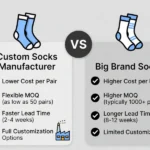
| Factor | Retail Sports Socks | Custom Sports Socks |
|---|---|---|
| Brand Control | None | Full integration |
| Performance Specs | Fixed | Adjustable |
| Inventory Flexibility | Limited | Scalable |
| Margin Opportunity | Low | Higher resale value |
| Long-Term Consistency | Variable | Controlled |
For structured teams and branded programs, custom offers stronger control and scalability.
What to Decide Before Ordering Custom Sports Socks
Keep it simple. Focus on five decisions.
1. Define the Sport
Different sports require different construction.
- Basketball – reinforced heel and arch
- Soccer – calf length and compression
- Running – lightweight and moisture-focused
- Hiking – full cushion and wool blend
2. Choose the Right Material Strategy
- Cotton blend for general training
- Polyester blend for high sweat environments
- Wool blend for outdoor conditions
SocksMaven uses OEKO-TEX compliant yarns, which supports retail resale and sustainability positioning.
3. Select Cushion Placement
Options include:
- Full cushion
- Half cushion
- Targeted cushion
Thicker is not automatically better. Strategic padding improves impact absorption without overheating.
4. Confirm Branding Approach
Decide early:
- Knit logo or embroidery
- Subtle branding or bold design
- Team-only or retail-ready
SocksMaven supports Jacquard knitting, sublimation, and embroidery for different use cases.
5. Plan Logistics and Timeline
Production is only part of the equation.
SocksMaven provides:
- Digital mockups
- Sample confirmation
- Express delivery in 3 to 7 days
- DDP global shipping
Clear logistics planning reduces delays and event risk.
Why Your Manufacturer Choice Directly Impacts Quality and Delivery
Custom socks are only as reliable as the factory behind them.
Since 1997, SocksMaven has focused on:
- Precision production machinery
- Ethical sourcing and SEDEX compliance
- Sustainable material standards
- Flexible batch structures
For procurement managers, manufacturing stability reduces operational uncertainty.
Consistency builds long-term supplier confidence.
When Custom Sports Socks Become a Smart Investment
Custom production makes financial sense when:
- You manage competitive teams
- You sell branded merchandise
- You organize recurring tournaments
- You need standardized performance specs
- You want stronger margin control
For casual personal use, retail may be sufficient. For structured programs and brand-building, custom delivers measurable long-term value.
Bottom Line
Sports socks evolved from basic foot protection to engineered performance systems.
Today, custom sports socks improve stability, reduce friction-related issues, and strengthen brand identity at scale.
If you’re ordering in volume, control matters.
Start with a small sample run through SocksMaven. Validate the structure. Then scale with confidence.