Skip to content

Which Sock Supply Chain Actually Works Better
For most brands, custom socks offer better long-term value than big brands.
But only if your supply chain is set up correctly.
The real decision isn’t about style. It’s about cost, speed, control, and risk.
What’s the real difference between custom socks and big brands
Big brands sell finished products.
Custom socks manufacturers build products around your needs.
That difference shapes how your business operates.
- Big brands offer speed and convenience
- Custom socks offer flexibility and scalability
If you want to build a brand, custom sourcing gives you control. If you only need stock, big brands are easier.
What custom sock manufacturing actually means
A custom socks manufacturer works under OEM or private label models.
You control the key elements of the product.
- Yarn and material blend
- Compression or cushioning
- Logo placement and design
- Packaging and branding
For example, a sports brand may choose moisture-wicking yarn with added support. A corporate client may create logo socks with custom packaging for events.
Why brands are shifting their sock supply chains
The traditional wholesale model is becoming less flexible.
Brands now want faster, more responsive sourcing.
- Demand for unique products is increasing
- Smaller batch production reduces inventory risk
- Faster development cycles improve competitiveness
- Global supply chains are more accessible than before
Even small businesses can now work with a custom socks manufacturer without large upfront commitments.
Key differences that impact your business
This is where most sourcing decisions are made.
Custom socks vs big brands
| Factor | Custom Socks Manufacturer | Big Brand Socks |
|---|---|---|
| Cost | Flexible based on volume | Fixed retail pricing |
| MOQ | 100–1000+ pairs typical | No MOQ |
| Lead Time | 15–30 days production | Immediate |
| Customization | Full OEM control | None |
| Branding | Fully owned | Not possible |
| Quality Control | Depends on supplier | Standardized |
The real cost breakdown most buyers miss
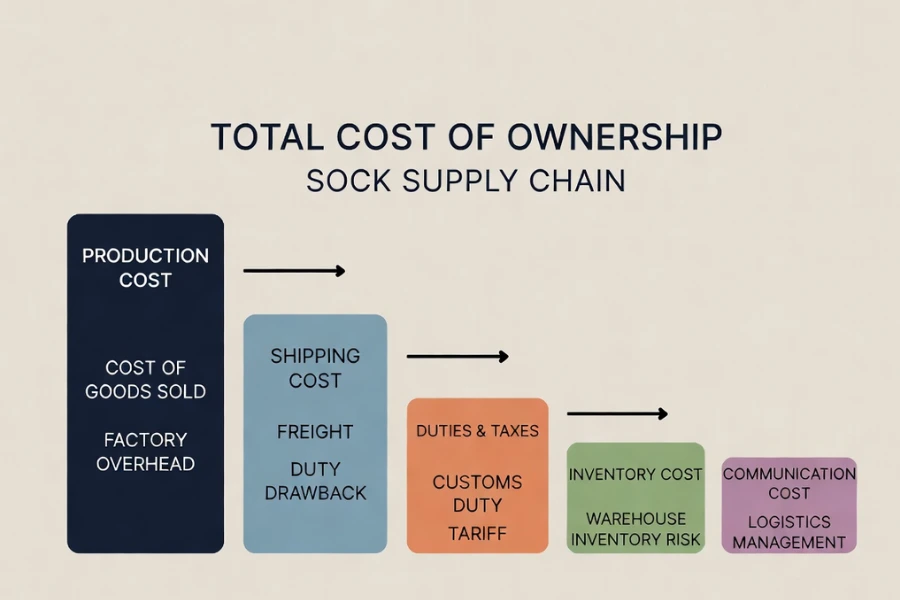
Most buyers focus on unit price. That often leads to poor decisions.
The more accurate metric is total cost of ownership.
This includes:
- Production cost
- Shipping and logistics
- Import duties
- Inventory holding cost
- Communication delays
- Defect and rework cost
For example, a lower unit price may come with higher MOQ and longer lead time. This increases inventory pressure and slows down your ability to react to market demand. In many cases, the final cost difference is much smaller than expected.
When to choose each option
Your decision should match your business stage and goals.
Choose custom socks if:
- You are building a brand
- You need unique designs
- You want control over materials and quality
- You plan repeat orders
Choose big brand socks if:
- You need products immediately
- You do not require customization
- You are testing demand with minimal setup
Real-world scenarios
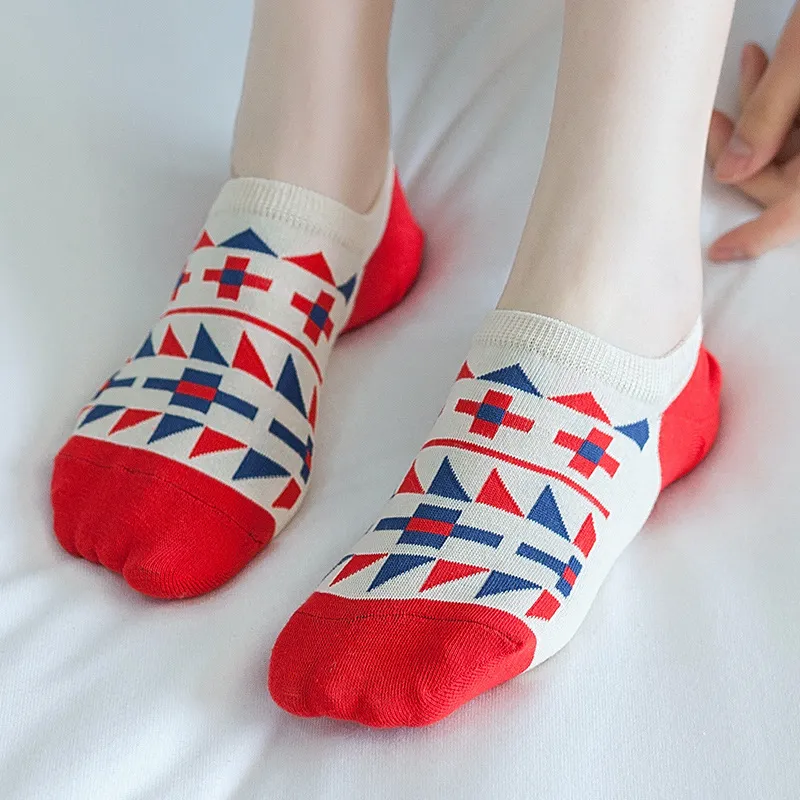
A new e-commerce brand orders a small batch of custom socks to test designs. They adjust quickly based on sales and avoid excess inventory. This makes custom manufacturing a better fit.
A company preparing for an event needs branded socks with specific packaging. Custom socks are the only option that meets the requirement.
A retail shop needs ready-to-sell products with no customization. Big brands provide faster access to inventory.
How to choose the right sock supplier
Follow a clear process to reduce sourcing risk.
- Define your use case
Sports, fashion, or promotional - Choose materials and features
Cotton, polyester, compression, grip - Set MOQ and budget
Align with expected sales volume - Shortlist suppliers
Focus on experienced custom socks manufacturers - Request samples
Always verify before placing bulk orders - Confirm lead time
Separate production and shipping timelines - Finalize agreement
Clarify pricing, defects, and ownership
Common mistakes to avoid
Many sourcing issues come from avoidable mistakes.
- Choosing based only on price
- Skipping sample validation
- Ignoring lead time definitions
- Overlooking packaging costs
- Not confirming customization limits
Small oversights can lead to larger operational problems later.
A smarter way to approach custom socks
The goal is not to find the cheapest supplier. It is to build a reliable supply chain.
A strong custom socks manufacturer should provide:
- Flexible MOQ for different order sizes
- Fast sampling to shorten development time
- Clear and predictable production timelines
- Consistent quality across reorders
- Global delivery support
SocksMaven focuses on making this process more manageable. With long-term manufacturing experience, it offers flexible order quantities, free design support, fast sampling, and reliable global shipping. This helps brands maintain control while reducing operational risk.
FAQ
What is the difference between custom socks and branded socks
Custom socks are produced based on your design, materials, and branding requirements, while branded socks are mass-produced with fixed styles. Custom options give you full control over product details and identity, making them better for differentiation, whereas branded socks focus on consistency and immediate availability.
Are custom socks cheaper than big brand socks
Custom socks are not always cheaper upfront, especially for small orders. However, they often deliver better long-term value by reducing inventory risk, improving brand recognition, and allowing better control over materials and production quality across repeat orders.
What is MOQ in sock manufacturing
MOQ, or minimum order quantity, refers to the smallest number of units a manufacturer will produce per design. It typically ranges from 100 to several thousand pairs depending on materials, customization complexity, and production setup requirements.
How long does custom sock production take
Custom sock production usually takes 15 to 30 days after sample approval. The timeline depends on design complexity, order size, and factory capacity. Shipping time is separate and should always be confirmed in advance.
Is factory direct sourcing better than trading companies
Factory direct sourcing often provides better pricing, faster communication, and clearer quality control. Trading companies can still be useful for smaller orders or for buyers who need support managing sourcing, production, and logistics.
Why is China a leading sock manufacturing hub
China has a well-developed manufacturing ecosystem, skilled labor, and advanced production technology. It also offers flexible customization, competitive pricing, and efficient global logistics, making it a preferred sourcing destination for many sock brands.
Final takeaway
If you need speed, big brands are simple.
If you want control, scalability, and long-term brand growth, custom socks are the better choice.
Start with your business goal, then build your supply chain around it.